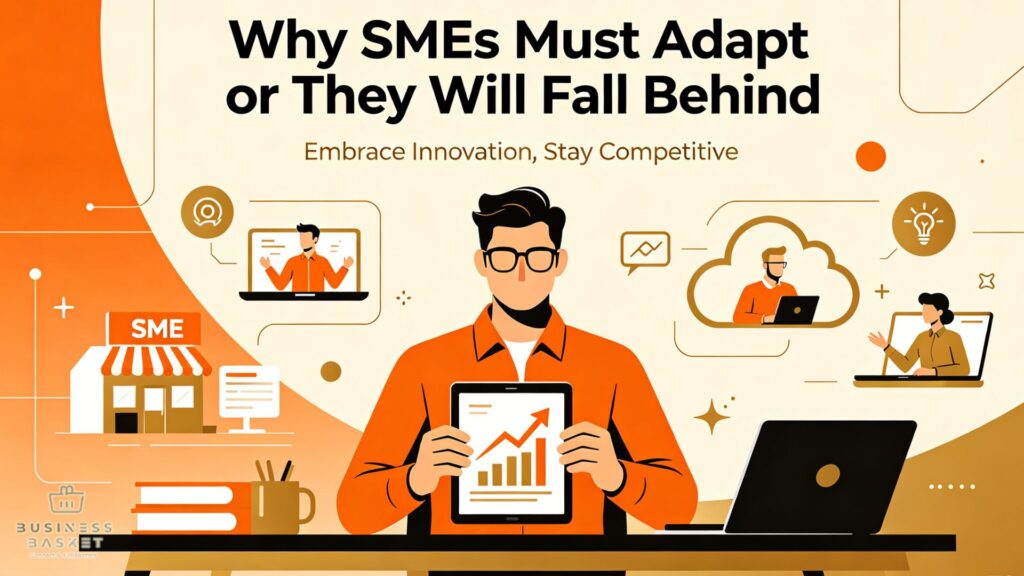
The market is no longer “competitive” in the traditional sense. It is now algorithmically saturated, AI-accelerated, and content-dense.
Every industry—from retail and services to consulting and events—is experiencing the same structural shift:
- Lower barrier to entry (AI tools, automation, templates)
- Higher output volume (more content, more businesses, more platforms)
- Faster trend cycles (what worked last month may fail today)
- Increased noise (similar offers, similar branding, similar messaging)
In this environment, businesses are not just competing with each other—they are competing with speed, distribution systems, and AI-enabled execution power.
And this creates a clear divide:
Businesses that leverage AI strategically will scale visibility and efficiency.
Businesses that do not will gradually lose relevance, even if their product is good.
This article breaks down what is happening, how SMEs should respond, and how a structured business networking community like Business Basket becomes a critical advantage in this new ecosystem.
1. What Is Really Happening in the Market (AI + Saturation Shift)
1.1 The “Content Explosion Economy”
We are now in a phase where:
- One business can generate 50–500 content pieces/month using AI
- Websites can be built in hours instead of weeks
- Ads, captions, scripts, funnels are AI-assisted
- Entire business models can be cloned quickly
This leads to market compression:
- Similar ideas
- Similar positioning
- Similar offers
- Similar visuals
1.2 The Real Problem: Not Competition, But Indistinguishability
The biggest issue is not “too many competitors.”
It is:
“Customers cannot tell the difference between options anymore.”
When differentiation becomes unclear, buying decisions shift to:
- familiarity
- trust signals
- community validation
- social proof ecosystems
This is where networking communities and ecosystems become powerful distribution anchors.

2. Why AI Changes Everything for Small Businesses
2.1 What AI Actually Does (Strategically)
AI does not just “make work faster.”
It changes:
- Content production cost → near zero
- Idea iteration speed → near instant
- Market entry barrier → significantly lower
- Competition density → significantly higher
2.2 How Winners Will Use AI
The winners are not just “using AI.”
They are:
- combining AI + human positioning strategy
- building multi-channel ecosystems
- producing consistent content velocity
- testing micro-niches rapidly
2.3 Why Most Businesses Still Fail with AI
Because they:
- use AI for output, not strategy
- lack positioning clarity
- produce content without distribution systems
- operate alone without feedback loops
3. The Future Market: Hyper-Saturation + Micro-Ecosystems
3.1 What the Next 3–5 Years Will Look Like
We will see:
- Thousands of niche brands in every industry
- AI-generated businesses competing with human businesses
- Hyper-personalized content streams
- Smaller but stronger communities
- Platform fragmentation (TikTok, SEO, communities, private groups)
3.2 Which Businesses Will Win?
Businesses that:
- belong to ecosystems (communities, networks)
- build authority clusters (not just content)
- leverage shared distribution
- gain trust faster through proximity and referrals
4. The Hidden Advantage: Business Networking Communities
In saturated markets, network = distribution system.
A strong business community provides:
4.1 Faster Market Learning
- What works now (not last year)
- What customers are currently responding to
- Real-time feedback from peers
4.2 Reduced Marketing Waste
Instead of guessing:
- campaigns
- ads
- content direction
You learn from collective experience.
4.3 Trust Compression
People buy faster when:
- recommended by peers
- validated in a trusted circle
- repeatedly exposed through network ecosystems
People also ask:
Q1: Why is the market becoming so saturated now?
Because AI tools have significantly lowered barriers to entry, allowing more businesses to create content, services, and platforms faster than ever before.
Q2: How can small businesses compete in an AI-saturated market?
By focusing on positioning, community-driven trust, and leveraging AI for speed while maintaining human-led strategy and differentiation.
Q3: What is the biggest mistake SMEs make with AI?
Using AI only for content creation instead of integrating it into full marketing, positioning, and distribution systems.
Q4: How does networking help in a saturated market?
Networking reduces uncertainty by providing referrals, shared insights, collaboration opportunities, and faster trust-building.
Q5: Which businesses survive AI disruption?
Businesses that are part of ecosystems, communities, and strong distribution networks rather than operating in isolation.
Why Business Basket & Networking
In a saturated, AI-driven market, businesses need more than tools—business owners need structured human ecosystems.
A community like Business Basket provides:
- Business owner-to-business owner connections
- Real-time market insight sharing
- Collaboration and referral opportunities
- Reduced marketing guesswork
- Faster growth decision-making cycles
Instead of operating alone in an overcrowded digital space, SMEs gain:
access, visibility, and trust through network proximity
Join a Business Growth Ecosystem
If you are a small business owner, entrepreneur, or service provider feeling the pressure of:
- increasing competition
- unclear marketing direction
- rising content saturation
- difficulty getting consistent customers
Then relying on AI tools alone is not enough.
You need people, feedback loops, and real-world business networks.
👉 Join Business Basket, a business networking community designed to help SMEs connect, collaborate, and grow in a rapidly evolving AI-driven economy.
Because in the next phase of the market:
It won’t be the businesses with the most content that win.
It will be the businesses inside the strongest ecosystems.