
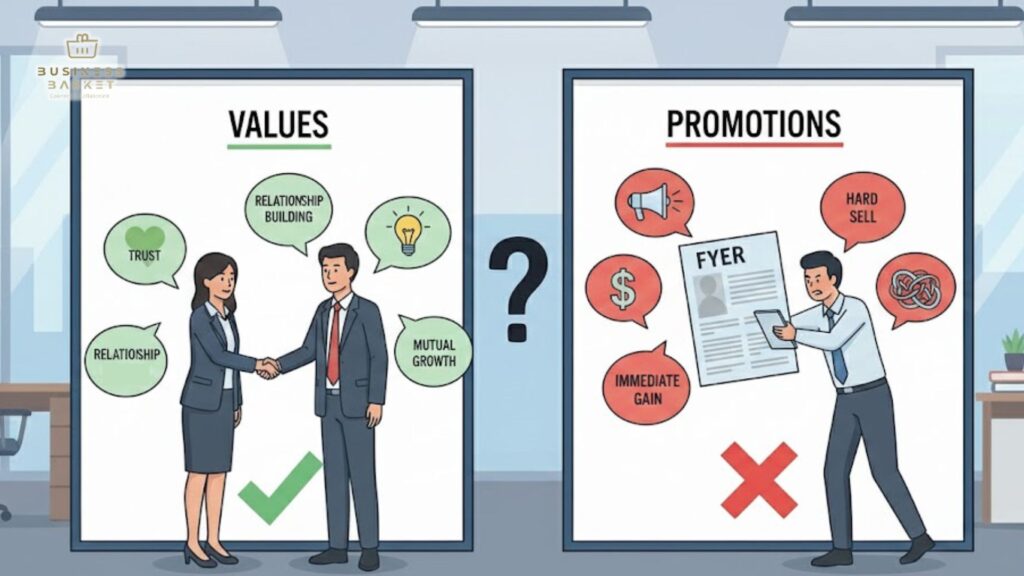
In every networking group, you will notice two types of people:
(1) those who share values, insights and genuine contributions, and
(2) those who only push promotions, offers, and sales messages.
Both show up with different intentions — and because of that, they leave very different impressions.
Understanding the difference can help you reflect on your own approach and improve how others perceive you.
1. People Who Share Values: The Relationship Builders
These are the members who consistently give, share, and support without always expecting something in return.
What They Share
-
Tips, insights, experiences
-
Encouragement, emotional support
-
Industry knowledge
-
Solutions to common challenges
-
Stories that inspire or educate
How They Make Others Feel
-
Safe
-
Connected
-
Understood
-
Appreciative
-
Curious to know more about them

The Impression They Leave
People who share value are seen as:
-
Trustworthy
-
Knowledgeable
-
Generous
-
Leaders in the community
This creates a pull effect: others naturally want to help them, recommend them, and support their business.
Why It Works
Networking is built on trust, not transactions.
When people feel you care about their success, they remember you longer and refer you faster.
2. People Who Share Only Promotions: The Transactional Sellers
These are the members whose messages are mostly:
“Buy now.”
“Join my event.”
“Here’s my offer.”
“Promo ending soon.”
What They Share
-
Discounts
-
Self-promotion
-
Flyers
-
Sales pitches
How They Make Others Feel
-
Pressured
-
Disconnected
-
Annoyed
-
Defensive
-
Uninterested
Because the focus is on getting, not giving, the audience tends to ignore, mute, or scroll past their messages.
The Impression They Leave
People who share promotions only are often seen as:
-
Desperate for sales
-
Self-centered
-
Not engaged in the community
-
Someone who shows up only when they need something
This creates a push effect: people feel pushed away instead of drawn in.
Why It Doesn’t Work Well
In a networking setting, members are there to build relationships — not to be bombarded by cold marketing messages. Promotions-only communication feels like a wall, not a bridge.

3. The Pain Points of the People Receiving Your Message
People in a networking group have their own mental filters. They ask themselves silently:
-
“Is this relevant to me?”
-
“Is this person genuinely contributing or just using the group as free advertising space?”
-
“Do I feel seen or just sold to?”
-
“Do I trust this person enough to refer my contacts to them?”
If someone keeps pushing promotions, the pain points stack up:
Pain Points Triggered by Promotion-Only Messaging
-
“I don’t know them well enough to care about their promo.”
-
“Why are they posting again? They never help anyone here.”
-
“This doesn’t benefit me.”
-
“They only appear when they want money.”
-
“I feel like I’m just their target audience, not their friend or peer.”
When people feel this way, they disconnect emotionally and mentally — and your message is lost.
4. Intentions Are Felt Before They Are Understood
In networking, people don’t just remember what you say.
They remember how you made them feel.
Even if you don’t say your intention out loud, people can sense it through:
-
your tone
-
the type of content you share
-
how often you engage with others
-
whether you show up during others’ wins and struggles
-
whether you give before you receive
If your intention is to serve → they feel connected.
If your intention is to take → they feel guarded.
Your energy communicates before your words do.
5. So Which One Works Better?
Without question:
People who share values win in networking. Always.
Because in networking:
-
trust > transactions
-
relationships > promotions
-
consistency > urgency
-
reputation > sales pitch
People support and refer those they like, trust, and feel good around.
Value creates that.
Promotion alone doesn’t.

6. The Winning Formula: Share 80% Value, 20% Promotion
Here’s a simple rule that works in every networking environment:
-
80%: insights, stories, support, knowledge, kindness
-
20%: updates, offers, promos, invitations
When you do this consistently, your promotions stop feeling like sales pitches.
Instead, they feel like opportunities to support someone they already trust.
Conclusion: Your Impressions Are Built Daily
Every message you share…
Every comment you add…
Every story you tell…
Every time you show up…
…creates an impression of who you are.
Networking works best not when you push your business, but when you grow your reputation.
People buy from brands.
People refer humans.
People remember how you made them feel.
So choose to be the one who adds value —
and watch how opportunities naturally start flowing your way.